03 · Advanced Reactors

Advanced Reactor Modeling & Simulation

Exploring diverse Generation IV reactor concepts, with current emphasis on modeling and simulation capabilities for molten salt reactors.

Research focus

Generation IV reactor concepts employ coolants, fuels, core designs, and system configurations that differ from conventional light-water reactors, giving rise to distinct physical phenomena and safety behavior. Evaluating these concepts requires coordinated analysis across multiple levels, from the core to the system and major components.

MONAMI Lab analyzes the normal, transient, and accident behavior of advanced reactors using multiphysics simulation. We couple reactor-physics, thermal-hydraulic, and other models to evaluate whole-reactor behavior and connect them with high-fidelity numerical analysis when detailed local physics must be resolved.

Beyond isolated code calculations, we aim to establish an integrated advanced-reactor simulation framework that captures both system-wide behavior and detailed local phenomena, supporting the design and safety assessment of emerging reactor concepts.

CURRENT FOCUS

Molten Salt Reactor Modeling

MONAMI Lab aims to develop analysis capabilities for a broad range of Generation IV reactor concepts. Our current effort focuses on molten salt reactors (MSRs), building connected models from core neutronics to system dynamics and transient behavior.

1. Multi-fidelity MSRE kinetics analysis

Group constants are generated from an OpenMC continuous-energy model through energy-group condensation and spatial homogenization. The resulting few-group data are transferred to a GPU-accelerated three-dimensional nodal solver coupled with a circulating-fuel kinetics model.

Results

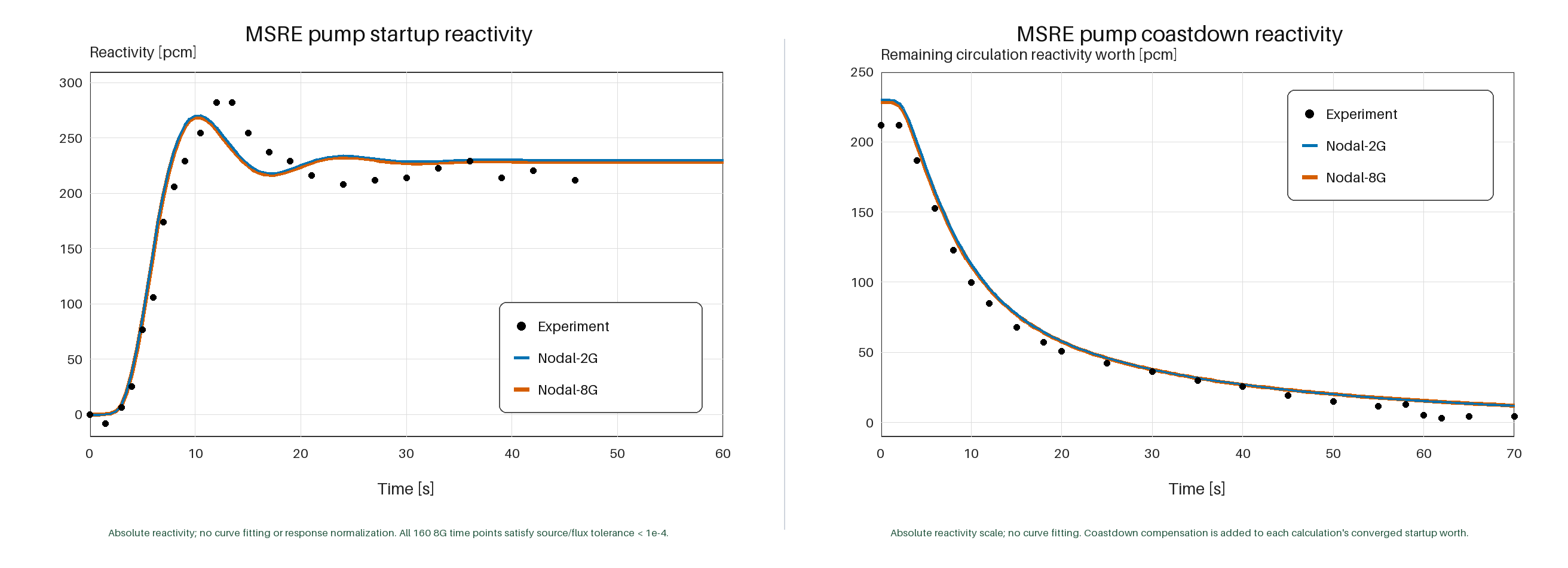
Steady-state neutron-flux distributions and MSRE pump startup and coastdown transients are assessed against high-fidelity calculations and publicly available test data.
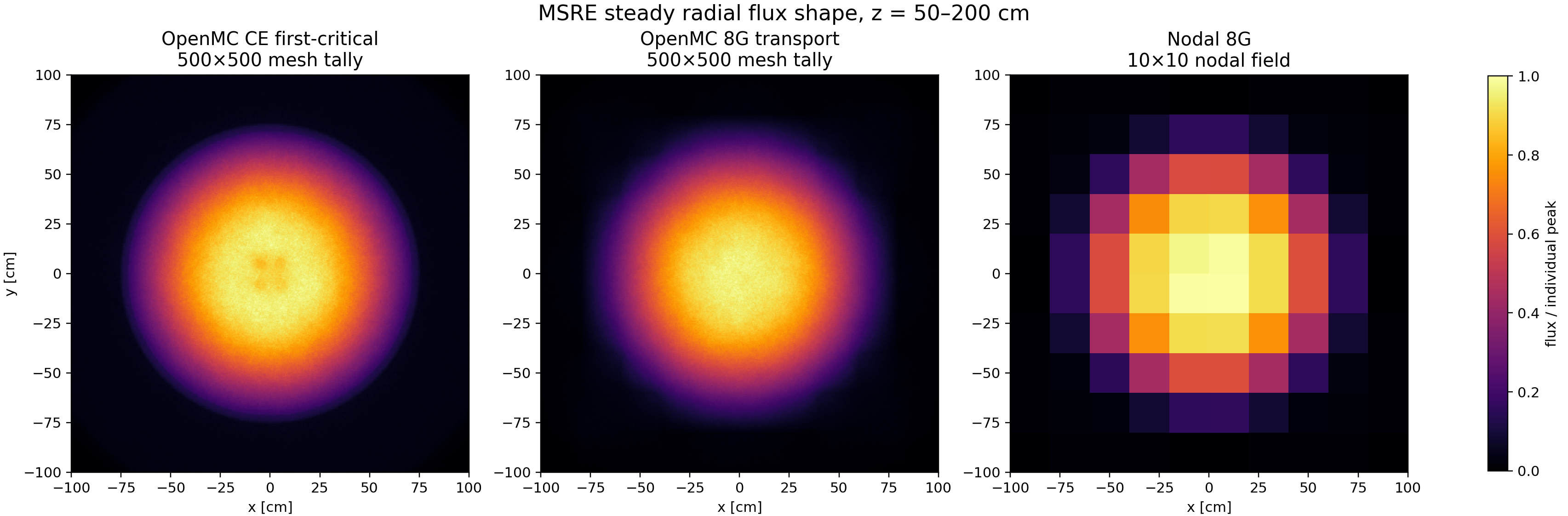
Comparison of OpenMC continuous-energy, OpenMC eight-group, and nodal eight-group MSRE radial neutron flux distributions
Steady-state radial flux: OpenMC CE, OpenMC 8G, and nodal 8G.
MSRE pump startup and coastdown reactivity compared with experiment
MSRE pump startup and coastdown transient validation.

2. Modelica-based system modeling

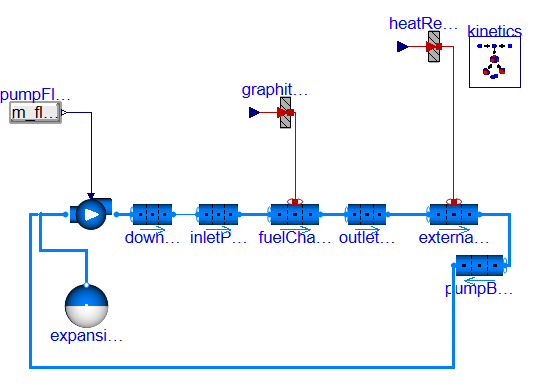
A modular MSR system model is being developed in Modelica by connecting pumps, flow channels, heat removal, graphite feedback, and reactor kinetics components. This framework supports system-level transient analysis and future coupling with higher-fidelity reactor models.

Modelica component diagram for a molten salt reactor system model
Modular MSR system model in Modelica.

TRANSFORM system-model validation

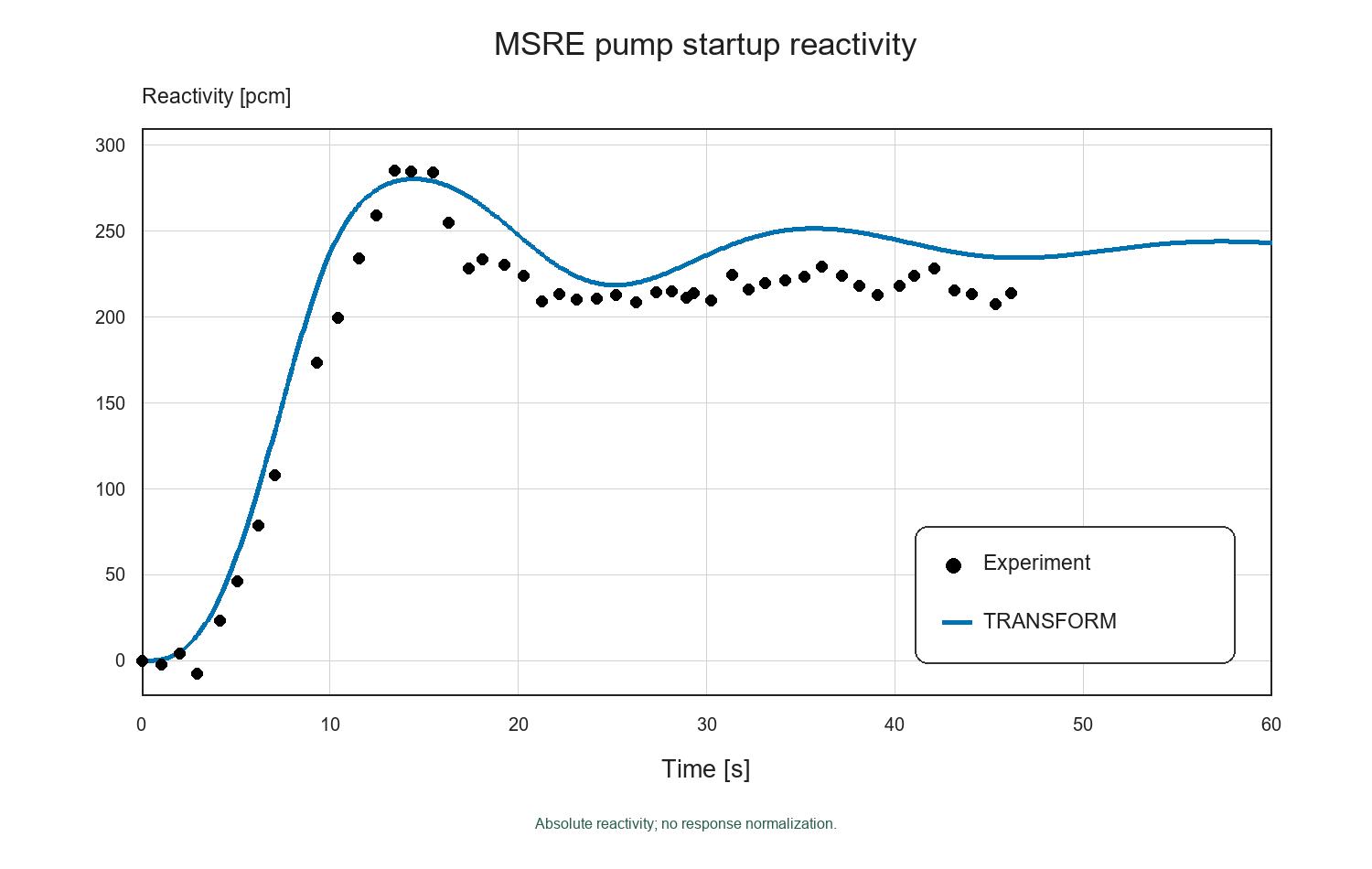
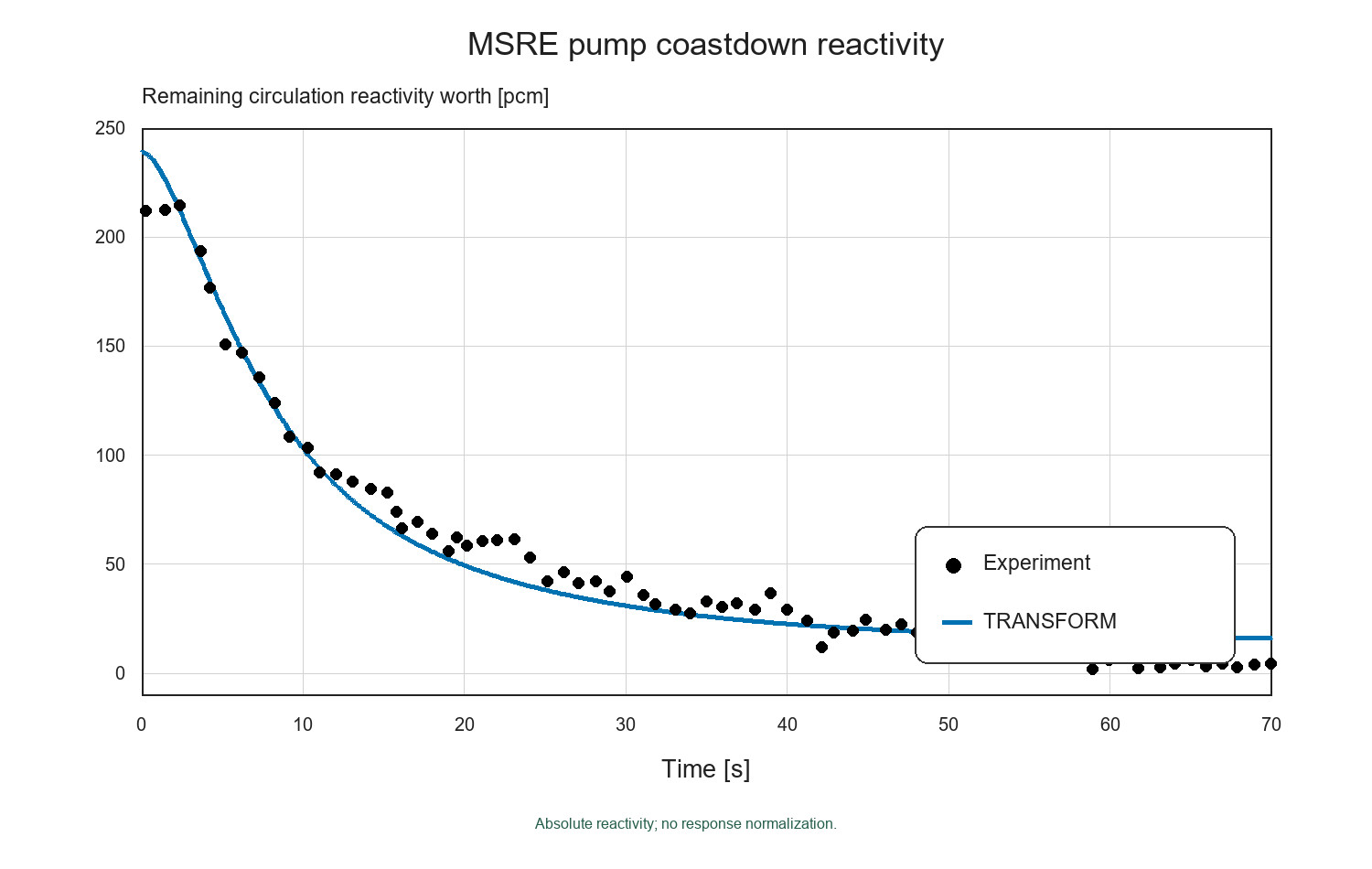
MSRE pump startup and coastdown reactivity predicted with the Modelica/TRANSFORM system model are compared with experimental data.

MSRE pump startup reactivity comparison between experiment and TRANSFORM
MSRE pump startup: experiment and TRANSFORM.
MSRE pump coastdown reactivity comparison between experiment and TRANSFORM
MSRE pump coastdown: experiment and TRANSFORM.

현재 집중 연구

용융염원자로 모델링

MONAMI 연구실은 다양한 제4세대 원자로 개념을 해석할 수 있는 계산 역량 확보를 목표로 합니다. 현재는 용융염원자로(MSR)에 연구 역량을 집중하여 노심 중성자 거동부터 계통 동특성과 과도 거동까지 연결하는 모델링 체계를 구축하고 있습니다.

1. MSRE 다충실도 중성자 동특성 해석

OpenMC 연속에너지 모델에서 에너지 군 축소와 공간 균질화를 수행하여 소수군 핵자료를 생산합니다. 생성된 핵자료는 흐르는 연료의 동특성 모델과 결합된 GPU 가속 3차원 노달 해석기로 전달됩니다.

해석 결과

정상상태 중성자속 분포와 MSRE 펌프 기동·정지 과도 결과를 고충실도 계산 및 공개 시험자료와 비교하여 계산 체계를 검증합니다.

OpenMC 연속에너지, OpenMC 8군 및 노달 8군 MSRE 방사형 중성자속 분포 비교
정상상태 방사형 중성자속: OpenMC CE, OpenMC 8G 및 nodal 8G.
MSRE 펌프 기동 및 정지 반응도와 실험자료 비교
MSRE 펌프 기동·정지 과도 검증.

2. Modelica 기반 계통 모델링

펌프, 유로, 열제거계통, 흑연 반응도 피드백 및 원자로 동특성 구성요소를 연결한 모듈형 MSR 계통 모델을 Modelica로 구축하고 있습니다. 이를 통해 계통 수준의 과도 해석을 수행하고, 향후 고충실도 원자로 해석 모델과 연계할 수 있는 기반을 마련하고자 합니다.

용융염원자로 계통의 Modelica 구성요소 연결도
Modelica 기반 모듈형 MSR 계통 모델.

TRANSFORM 계통 모델 검증

Modelica/TRANSFORM 계통 모델로 계산한 MSRE 펌프 기동 및 정지 반응도를 실험자료와 비교하였습니다.

MSRE 펌프 기동 반응도의 실험자료와 TRANSFORM 계산 결과 비교
MSRE 펌프 기동: 실험자료와 TRANSFORM 계산 결과.
MSRE 펌프 정지 반응도의 실험자료와 TRANSFORM 계산 결과 비교
MSRE 펌프 정지: 실험자료와 TRANSFORM 계산 결과.